Myanmar (also known as Burma but was changed on paper to Myanmar by the country’s military rule in 1989 after thousands died during an uprising against the government) has a codified constitution that was created in 2008. Before gaining independence in 1948, Myanmar had two quasi-constitutions which consisted of the Government of Burma Act 1935 and Constitution of Burma under Japanese Occupation 1943. Since then it’s first and second constitution were formed in 1947 and 1974, with it’s second being revoked by military rule in 1988 until it’s current (third) constitution was published after a referendum in 2008.
The purpose of the referendum for the new constitution was an attempt towards their road-map to democracy which worked to restore democracy within the country, even though the opposition sees it as a tool for continuing military control (from the Tatmadaw – Myanmar armed forces) of the country. This is mainly due to 25% of seats within the parliament of Myanmar being reserved for serving military officers, the ministries of home, border affairs and defense having to be headed by serving military officers and the military being able to appoint one of the two vice presidents.
This could harm the rights and safety of the people living within Myanmar as it means the country’s civilian leaders have little influence over security within the establishment, which is clearly shown by the fact that Myanmar’s leader Aung Sann Suu Kyi, refuses to condemn the powerful military or acknowledge accounts of murder, rape and possible genocide of Rohinga Muslims.
The 2008 constitution is often regarded as fraudulent and undemocratic by the opposition and those outside of Myanmar despite being created out of a referendum, as it’s draft adhered strictly to to the 6 objectives which included giving the military the leading role in the future state, even after 50 years of military rule. The military’s authority is further enforced by the fact proposed changes need to be approved by 75% of both houses of the Assembly of the Union before going to a referendum where changes must be approved by at least 50% of registered voters, rather than 50% of those voting.
The military’s political dominance continues as only 4 minor changes gained the required support out of 114 constitutional reforms that were put forward by the National League of Democracy,none of which limited or revoked powers or privileges that belong to the military. Votes for these amendments occurred for 9 days leading up to the 20th of march 2020 but the focus now, has been shifted onto preparing quarantine centres even though the official Covid-19 count for Myanmar remains at zero, possibly shifting the country’s attention away from their democratic society and toward the world-wide pandemic.
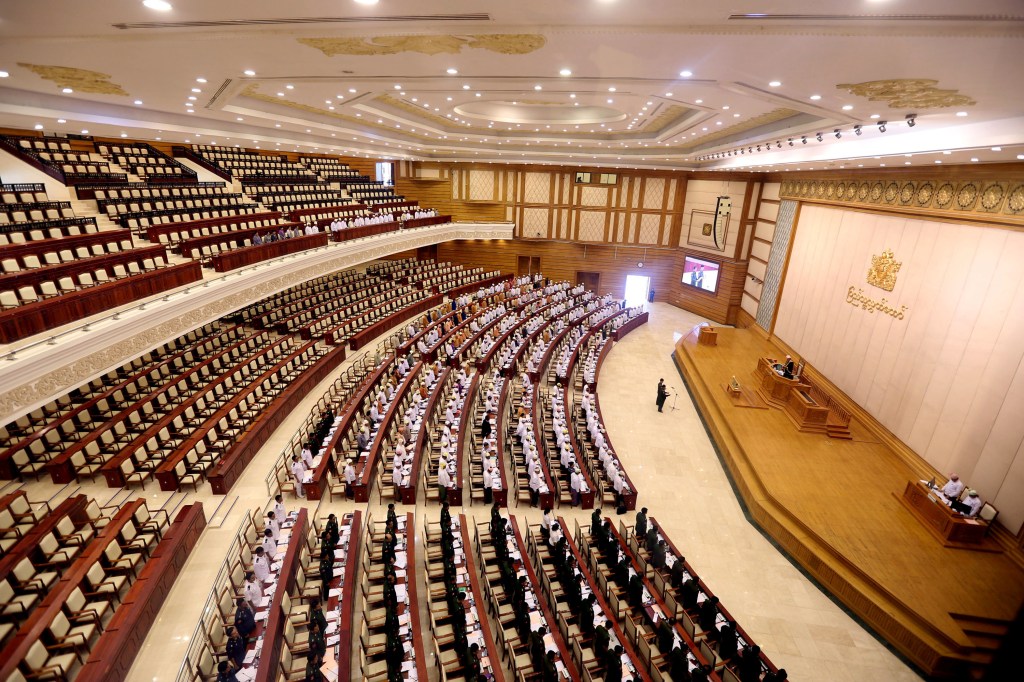
Photo taken on Sept. 11, 2014 shows a scene of the 11th parliament sessions of the Union Parliament in Nay Pyi Taw, Myanmar.
 Rebecca's A-Level G&P Blog