Featured

Fear : Trump in the White House {REVIEW}

Bob Woodward has worked for the Washington Post since 1971 and as an investigative US journalist wrote the book “Fear: Trump in the White House”, in 2018, which (as you may have guessed) focused on Donald Trump’s presidency.

Among the more serious topics covered in the book, I was particularly interested in Trump’s recklessness as president in regards to his constant need to pull out of long standing treaties and trade agreements, which were then swiftly avoided by his staff simply removing the paperwork he needed to sign from his desk. Trump’s irresponsible tweets also became a key factor throughout his campaign and his presidency and also made for interesting comparisons to UK politics as his communication style was considerably untameable (trust me many people have tried).

Overall, this book covered a wide array of issues which ranged from Trump’s informal and leadership style (both publicly and behind closed doors) all the way to the most important policy proposals of his presidency, regarding migration, trade and US influences within the Middle East. The book also touches upon some areas of scandal (which happen to appeal to me most), such as Trump’s Ex campaign chairman (who is now in Prison for tax fraud ) whom followed a midtown bondage and Swingers club on twitter, unknowing it to be a public forum. In addition to this there are multiple references to Ivanka Trump’s meddling in White House affairs and the confrontation often brought between herself and Trump’s chief strategist Steve Bannon (who is now in prison over fraud regarding Trump’s wall).

As for the writing of the book, it felt rather difficult to read, mainly because it followed a chronological order, and only focused on one topic at a time, whilst not finishing it entirely and coming back to it later in the book, which left me constantly skimming back to earlier chapters to recap some of the details and especially names (which were in abundance). Saying this, the chapters only have numbers and lacked any clear headings or even a contents, which is considerably confusing and inconvenient, especially in a non-fiction book where you’d be expected to look back and re-read certain topics covered. This overall left the feeling of having just read a bunch of short, uncoordinated news articles that had difficulty leading form one to another. The ending here, was also non-existent and no firm conclusion was really drawn from any discussion brought up in the book.

{Here are some honourable quote mentions that baffled me}

“I was elected to represent the citizens of Pittsburgh, not Paris” // Trump’s “reasoning” for pulling out of the Paris agreement regarding the threat of climate change.

“If that’s the standard, let me go get some pictures of Sub-Saharan Africa. Okay? let me get some of whats happening down in Guatemala and Nicaragua. If this is the standard for a f*cking missile strike, lets go everywhere. Let’s do everything.” // Bannon’s response for Trump’s need to bomb the Middle-East every chance he gets.

“On many sides. On many sides.” – “There is no upside to directly condemn Neo-Nazis and those that are motivated by racial animus” – ‘David Duke, the well know former Ku Klux Khlan leader, tweeted “Thank you President Trump for your honesty & courage to tell the truth about #Charlottesville” // Trump’s response and comments to the Charlottesville ‘Unite the right’ rally, as well as one of the most disgusting ally’s to have on board.

Featured

The state of Texas and the Corona Virus

It’s safe to assume that corona virus has been taking it’s toll on the planet for the past few months and with endless hours (which aren’t so endless when you are teaching yourself 4 different a-levels) in the UK’s lock down there is often time to ponder what else is going on in the world, like Texas in the USA.

The USA has 50 federal states, meaning they all have significant control over their individual state (apart from their nation wide laws that have been approved by congress and the president). Included in this control is the precautions taken around the corona virus outbreak, meaning each states’ response to the pandemic is different.

In Texas, like many other parts of the US issued a statewide stay at home mandate on April 2nd 2020 after many Texan’s did not adhere to the more localised stay at home order put forward by local officials. The order, similar to the UK, involved staying at home and only going out to do essential work or to go to the shops. In order to put across the message that people could leave their house in certain circumstances, the governor, Greg Abbot, hesitated with the naming of such an order as “shelter-at-home” or “stay-at-home” as it may lead residents to believe they can never leave their homes; thus informally referring to it in news broadcasts as “Essential services and activities only”. To enforce this mandate, the state has issued an up to $1,000 fine, jail time for up to 180 days or both, if conditions are not met, even though law enforcement had issued a statement claiming that they are focusing on issuing warnings and educating people instead. A further precaution Abbot is made is to postpone the May 26th primaries to July to reduce the spread of the virus.

Along with Texas and the stay at home orders issued, there has been a surprising amount of scandal too. One stems directly from the stay-at-home order as, unlike Washington state where there was a statewide ban on spiritual services, Abbot encourages churches to operate remotely but if necessary, members can meet face-to-face whilst following social distancing guidelines, thus specifically exemplifying every other religion in Texas; yes, that does only make up 2% of Texas’ religious distribution, but discriminatory nonetheless. In addition to this there has also been a hubbub of news regarding Bill Gravell, a Texas Judge who violated his own stay-at-home order by going to his grandson’s birthday party on April 7th , the same day he extended his order for the whole county to stay home until the end of April. Following this trend with my personal favourite, Texas Mayor Becky Ames was forced to apologise after violating her own stay at home order to go and get her nails done (of all things), claiming it was a “lapse of judgement”. She is now under investigation from the district attorney.

Politician ordered beauty salons to close because of coronavirus ...
Beaumont major Becky Ames getting her nails done

Over the past month, since the various stay-at-home orders were issued, American’s all over the US have been protesting against it, claiming it is tyranny and that all jobs are essential. In Texas particularly, people clumped in their masses with banners and placards, wishing to be a free America once again. With the right wing media and US president Donald Trump supporting the protests, and some Texas businesses opening out of defiance, just one month later, lock down restrictions are being relaxed in Texas, as well as a few other US states. In Texas, most public places, including parks and restaurants, re-opened on May 5th, with cosmetic shops, such as barbers and (if you’d believe it or not) tanning salons (necessary activity? i think not) following on the 8th and Gyms, offices and manufactures coming soon on the 18th.

A Few Hundred Protest COVID-19 Orders At Texas Capitol | KERA News
Corona Virus Protest – Austin, Texas

All of this early relaxation has already had detrimental consequences as just the day after the first phase was introduced, Texas recorded 1,033 corona virus cases – the highest daily number so far, and there are fears that the reopening Texas could cause another huge wave of corona virus cases, and with it, lots more deaths.

Compared to the UK’s Clap for the NHS and almost the whole country abiding by Johnson’s stay-at-home order, such rebellions are unheard of. The extremities go as far as three numpties from Slough climbing up Old Harry Rocks and requiring 45 emergency service workers to rescue them. But despite these Covidiots (thank you The Sun, I will be using this term frequently from now on) the UK has a much lower death toll then the US as a whole and the government aims to keep it low.

But who knows I may just choose a tan over my life.

(No, I won’t)

Will Leaving the EU bring back Parliamentary Sovereignty?

The argument of whether or not the UK should leave the EU has been around ever since we joined back in 1973. Over the years, there has been a shifting of opinions between and across the two main parties but in January 2020 it was Boris Johnson’s conservative government that brought the UK out of the European Union. Throughout the leave campaign, one of the strongest arguments for the venture would be that our UK parliament would regain it’s sovereignty, but is this really the case?

Popular sovereignty is, essentially, power to the people and it is them that has the most say. In the UK this isn’t often the case as our parliamentary system incorporates MPs, which are elected by the people but once in the house of commons, they only have to adhere to party whips, so do not always follow the wishes of it’s constituents. In 2016, the referendum on exiting the European union brought in a high level of popular sovereignty as, although the referendum was not binding, it would of brought masses of public discontent if the government were to ignore the public’s wishes.

This particular example, however does not prove popular sovereignty ‘trumping’ parliamentary sovereignty in the UK as it is still only up to parliament to decide how the Brexit process, and any bills related to it, will pan out (e.g a soft or a hard Brexit). This of course can be countered by the 2011 European Union act which meant any new alterations tot our treaty with the EU which would mean a transfer of UK power to the EU , would require a referendum, this is known as a ‘referendum lock’.

Once particular deals go through regarding Brexit, there is often the question as to whether or not power retrieved by the UK government will be held solely within Westminster or throughout the devolved nations. This would seem like the obvious way forward as the restrictions on the UK are almost all regarding legislation, however, since tony Blair’s labour government transferred a lot of power to each of the devolved bodies in 1999 as a part of their manifesto, this means that Scotland now has some legislative power, and does not have to follow all areas that are covered by legislation set by Westminster.

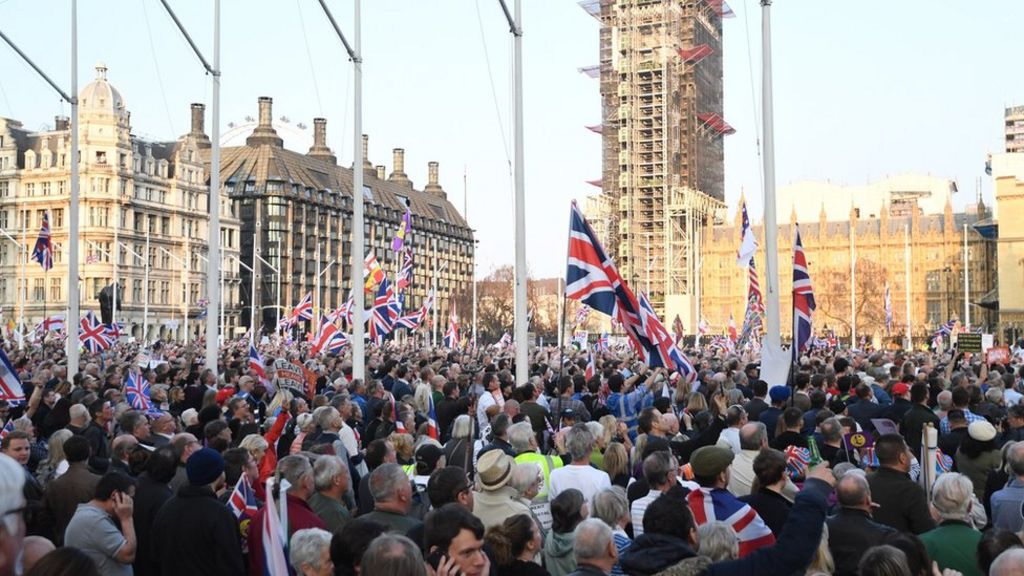
Brexit: Protests held at Parliament over delay - BBC News
Brexit protests at Westminster after it’s delay

Has the Role of backbench Mps been enhanced in recent years?

Backbenchers make up the majority of the house of commons as it is the commonly known term for MPs that do not sit on the front benches (shocking I know) which are made up of the cabinet and shadow cabinet. These backbenchers have numerous roles which include getting involved and voting on government legislation, performing government scrutiny and being representatives for their constituencies.

Backbench MPs are vital in the legislative process as it is they who hold the majority of votes within the house of commons. Backbench MPs often have to conform to party lines when voting on policy in order to act as delegates to their party, but in some instances backbench rebellions occur when numerous backbench MPs disagree with particular legislation, for example in 2003 when lots of Labour backbenchers voted against Blair’s influence in the Iraq war. Furthermore, Backbench MPs can get involved in policy-making is through private members bills, even though they are fairly challenging to pass, especially without the governments support. Overtime, Select Committees (made up of backbench MPs) have become more involved in the legislative process, such as the 2016 Exiting the European Union select committee in the Brexit process. Findings made from select committees, however only warrant a response from government and they do not have the authority to enforce the finding into policy.

Scrutiny is very important within our government as it is vital to hold them to account. Back bench MPs can be involved in this form of scrutiny through Prime Minister’s Questions (PMQs). Such PMQs only take about half an hour and are not compulsory to attend but since John Bercow was voted in as speaker of the house of commons in 2009, involvement and quality of PMQs has dramatically increased as he has shifted focus back onto backbench MPs and to move along long-winded answers so that more questions can be answered. Despite Bercow’s efforts, there is no statistical evidence as to the amount of backbench questions that have led to government action.

There is often conflict over how a backbench MPs represents their constituents within parliament. The first idea is the delegate model whereby that MP should feel obliged to follow the wishes of their constituents, for example voting against any Brexit deals put forth by Theresa May after the 2016 Brexit referendum if their constituency voted to remain within the European Union. This idea, however, does have it’s flaws as it is impossible to account for every constituents beliefs as, due to the FPTP voting system, a strong number of constituents didn’t vote for that MP in the first place, so an MP trying to please everyone is bound to have a strenuous task on their hands. The second idea is that of the trustee model. This model proposes that as a constituency votes for their MP they are more or less passing over their mandate to vote on certain legislation within parliament and their MP, along with their political expertise, is trusted to make good decisions based on their own merit. In modern politics, the politico model is seen as both models are used ,in different situations, by the same MP. Overtime, however, an MPs role in representing their constituents has not been enhanced in any way as both models and their arguments are still being put forward today.

Petition · Back bench MPs must take control of Brexit by forming a ...
House of Commons

How does Lobbying Impact British Politics?

Lobbying is the process of persuading to meet with key political figures and trying to persuade them to support your aims. It is most commonly recognised in the USA through the sheer size of it’s lobbying industry but it is growing within the UK too.

Here are some recent examples of lobbying within the UK:

In January 2020, Christopher Pyne was formally warned he was banned from lobbying for the defence contractor Saber Astronautics for 18 months since it won $2.7m in government work during his time as minister. This situation highlights the difficulties faced when trying to enforce lobbying rules as although Pyne is banned, his colleague, GC Advisory’s principal, Adam Howard, is not.

Lobbyists a can be seen to have a substantial impact on mainstream policy too. This is shown by the conservative’s election manifesto being written by Rachel Wolf, a lobbyist from the fracking company Cudrilla, which sparked outrage amoung major internet companies such as amazon and Facebook who raised concerns over whether the lobbyist’s paying clients could influence the party’s polices – questioning the democracy of our country as it means the rich and frackers are paving the way for the future of our country, despite there being a growing trend of the general pubic disagreeing with fracking.

Foreign Lobbying also has an impact on British politics as a total of eleven wealthy american donars have given more than £2.86m to right wing UK groups in the past 5 years. This clearly targets the front line of our government since most of the money goes to the conservatives who have been in power in the UK since 2010.

For more information see:

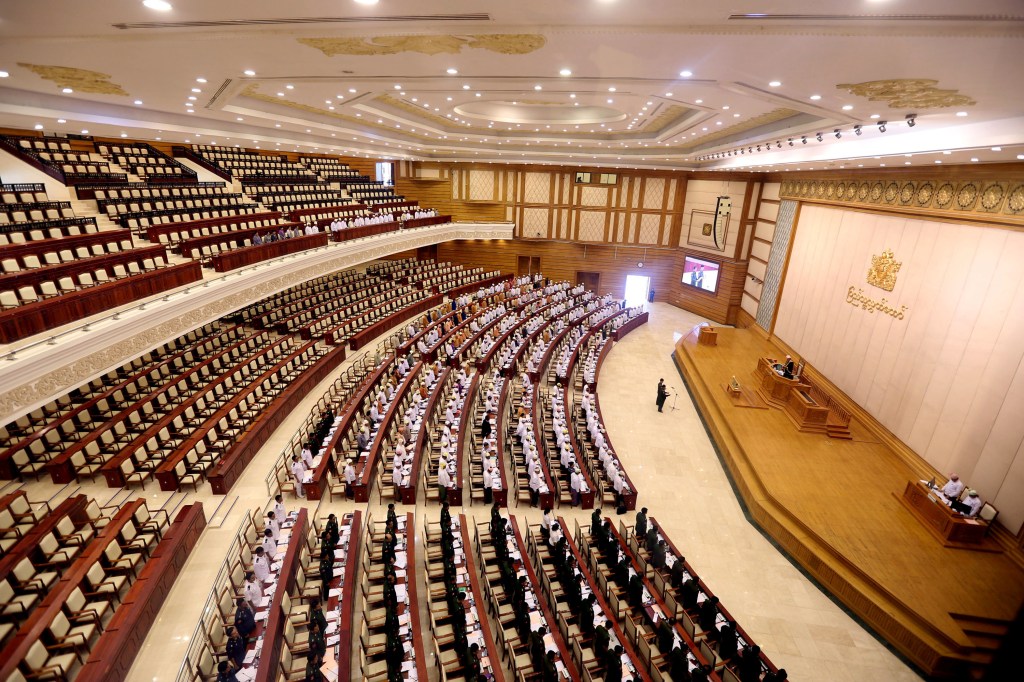
Myanmar's Constitution

Myanmar (also known as Burma but was changed on paper to Myanmar by the country’s military rule in 1989 after thousands died during an uprising against the government) has a codified constitution that was created in 2008. Before gaining independence in 1948, Myanmar had two quasi-constitutions which consisted of the Government of Burma Act 1935 and Constitution of Burma under Japanese Occupation 1943. Since then it’s first and second constitution were formed in 1947 and 1974, with it’s second being revoked by military rule in 1988 until it’s current (third) constitution was published after a referendum in 2008.

The purpose of the referendum for the new constitution was an attempt towards their road-map to democracy which worked to restore democracy within the country, even though the opposition sees it as a tool for continuing military control (from the Tatmadaw – Myanmar armed forces) of the country. This is mainly due to 25% of seats within the parliament of Myanmar being reserved for serving military officers, the ministries of home, border affairs and defense having to be headed by serving military officers and the military being able to appoint one of the two vice presidents.

This could harm the rights and safety of the people living within Myanmar as it means the country’s civilian leaders have little influence over security within the establishment, which is clearly shown by the fact that Myanmar’s leader Aung Sann Suu Kyi, refuses to condemn the powerful military or acknowledge accounts of murder, rape and possible genocide of Rohinga Muslims.

The 2008 constitution is often regarded as fraudulent and undemocratic by the opposition and those outside of Myanmar despite being created out of a referendum, as it’s draft adhered strictly to to the 6 objectives which included giving the military the leading role in the future state, even after 50 years of military rule. The military’s authority is further enforced by the fact proposed changes need to be approved by 75% of both houses of the Assembly of the Union before going to a referendum where changes must be approved by at least 50% of registered voters, rather than 50% of those voting.

The military’s political dominance continues as only 4 minor changes gained the required support out of 114 constitutional reforms that were put forward by the National League of Democracy,none of which limited or revoked powers or privileges that belong to the military. Votes for these amendments occurred for 9 days leading up to the 20th of march 2020 but the focus now, has been shifted onto preparing quarantine centres even though the official Covid-19 count for Myanmar remains at zero, possibly shifting the country’s attention away from their democratic society and toward the world-wide pandemic.

Bill Defeats in the House of Lords

Over the past 14 years, 435 bills have been defeated in the house of lords, one of which is the ‘Climate Change act 2008(2050 target amendment) order 2019’.

This bill proposed, that because of recent developments in the scientific knowledge surrounding climate change, the Secretary of State suggests that the initial act (of 2008) needs to substitute “80%” to “100%”,when regarding  the net UK carbon account  (the net amount of UK emissions of targeted greenhouse gases for a period adjusted by the amount of carbon units credited or debited to the account). Thus ensuring the net UK carbon account will be lower than the 1990 baseline.

The defeat of this bill (with a majority of -39), however, was justified as the government had not explained how the net-zero carbon emissions target by 2050 will be met and did not include how greenhouse gases from international aviation or shipping would impact the target.

This significance of this defeat wasn’t great as it was perceived as a non-fatal motion, meaning that it didnt stop the motion from becoming law, it was only used by the house of lords to indicate concern.

Back in June the (then) prime minister, Theresa May, was a stronger advocate for this bill even though, at that time, no full impact assessment had taken place. The instrument did, however, come into effect on the 27th of june 2019.

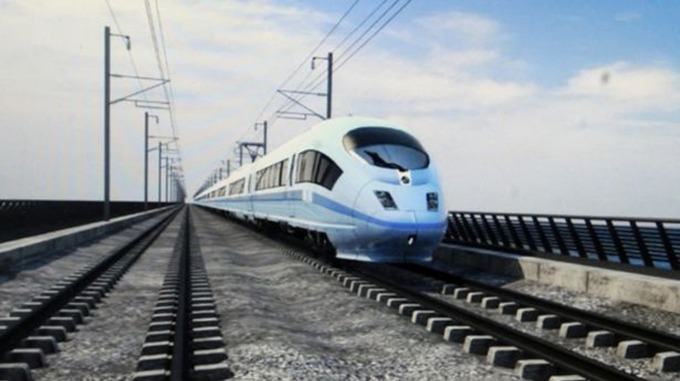
How Happy is everyone with High Speed 2 ?

The High Speed 2 railway plan was pitched and accepted by the Labour party back in 2009. It’s main focus was to re-balance the UK’s economy between north and south and to boost it by billions each year, by employing up to 25,000 workers to build the line, nearly 100,000 jobs created once the line is completed, and the estimated £34bn in fare revenue over a 60-year period. The development was also planned to cut down journey times between London, Birmingham, Manchester and Leeds. This was thought to be achieved during phase one by running the trains up to 14 times per hour in both directions along with having up to 1,100 seats per train; tripling the train capacity along this route, in order to reduce overcrowding. 

No-one, however, believed that it would have so many financial issues. This was partially due to the original estimate of £56bn, to build the railway, being presented to parliament. This figure then kept growing from £62bn to £81bn and (as of September 7th, 2019) up to an eye-watering £88bn. There were doubts over HS2’s budget very early on which were discovered by the project’s former infrastructure consultant, Michael Byng who (as well as turning to help those affected by HS2) claimed that the £27bn budget for phase one (London to Birmingham) contrasted with every other realistic estimate, he claims the he told senior members of the project and they simply sent him on his way. HS2 officials have publicly denies that they are in trouble but that they acknowledge that the project is “facing challenges to keep costs within budget”. 

One of the main hubs of this huge railway is London, and if you’d ask anyone, they would tell you that land there definitely isn’t cheap, unless they were working for HS2. Doug Thornton was a former employee of HS2 and oversaw acquiring all the land needed in order to build phase one of the track, he states that the budget set aside for the compulsory purchase of property was “appalling” , with blocks of flats being bought for £500 and a house with a garden in Euston for £600. Thornton was fired after walking out of his work’s premises after morally refusing to give a presentation, before the scheme as confirmed by parliament, to board members by using false numbers that would undercompensate people by 100’s of millions of pounds. HS2 also claims that they are working on and improving the estimate but an investigation by the national ordit office, found that their property estimates did increase significantly but they hadn’t been required to provide it’s updated estimates to parliament so MP’s voted and approved of the scheme without hearing these updated figures. HS2 is also taking the keys to people’s properties before paying out compensation, this leaves families and smaller businesses robbed as they often cannot afford to relocate without the compensation money that HS2 would promise to give them but is no-where in sight. 

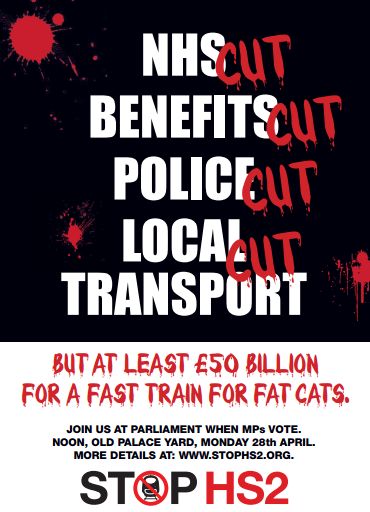
Larger groups of people are also seen to be speaking out against HS2; such as the pressure group STOP HS2, who campaign against this scheme as it will “destroy natural beauty and ecosystems” and increase carbon dioxide emissions. Many people in Birmingham are also complaining about the promise of 30,000 new jobs being created during phase one, as a disproportionate amount are in London. The huge amounts of compulsory purchases are also ruining living lives as well as dead ones as, in order to make way for the main station in London, archeologists are working hard to carefully remove hundreds of thousands of skeletons from an ancient burial ground dating back to 1788. 

So far More than £1.25bn has already been spent on buying London properties alone and HS2 is still negotiating more purchases, despite a government review in October into whether the project should even continue. Many of the doubts expressed by parliament are clear as they include the drastically rising costs and the vast delays, since phase one was scheduled to be finished on 2026 but that figure has now been pushed back to between 2028 and 2031.  

So as the HS2’s 225mph top speed, is the only speedy thing about this project, many people as well as parliament are left with a lot of questions: Will parliament will allow the completion of one of the world’s most expensive railway? Do the national benefits outweigh the costs? Or is HS2 just a “fast train for fat cats” ? 

Bercow and the Brexit Withdrawal Bill

Bercow’s intervention in the process of the Brexit withdrawal bill was far from expected as the 3rd bill had not even been seen yet, making the timing of his 1604, based statement especially surprising. Along with this came the criticism that Bercow was getting between the executive and parliament, rather than just standing up for the parliament. Bercow’s intervention also puts more pressure on the prime minister to hold her indicative votes, to see where their loyalties or preferences lie. People on both sides of Brexit, however, are agreeing with what Bercow has said as they believe that it wont such a considerable effect . This is primarily because it would have only created issues if the bill would have passed on the Tuesday, which -in fact- was thought to be very unlikely.

This overall, confused many MP’s, the general public and most likely Theresa May as Bercow has left quite a hurdle for Brexit to get over.

Design a site like this with WordPress.com
Get started